The online mag hardCOREware.net has put together an overview of portable storage devices (i.e., flash drives, memory sticks, portable hard drives). Useful reading, even if you're not planning on buying any new toys for the next few months.
The only things I might add is to point out that there are generally cheaper options out there. I use a laptop drive in a portable housing; Mike uses his iPod. And of course, there's this.
9.30.2005

Qual Res in Europe
The latest issue of FQS 6(3) focuses on the State of the Art of Qualitative Research in Europe. Include articles on methodological trends, innovations, and national-level studies.
For those unfamiliar with Forum: Qualitative SocialResearch, I highly recommend you browse the back issues. This online, peer-reviewed, and multilingual journal has covered some of the leading questions in qualitative methods in recent years. Well worth a read.
For those unfamiliar with Forum: Qualitative SocialResearch, I highly recommend you browse the back issues. This online, peer-reviewed, and multilingual journal has covered some of the leading questions in qualitative methods in recent years. Well worth a read.
9.28.2005
e-Social Science Position Announcement
The UK's ESRC National Centre for e-Social Science is accepting applications for a three-year Research Associate position.
They are looking for recent PhDs in social science or computer science, with strong interdisciplinary research experience with computing technologies. Must also have strong communications skills, not be a pain in the arse, and be willing to travel.
Pay is £19,460 to £25,699, depending on experience.
Applications must be submitted by October 5th. See website for further details.
They are looking for recent PhDs in social science or computer science, with strong interdisciplinary research experience with computing technologies. Must also have strong communications skills, not be a pain in the arse, and be willing to travel.
Pay is £19,460 to £25,699, depending on experience.
Applications must be submitted by October 5th. See website for further details.
Superlatives, science, and common sense
From the HUMANIST listserv, this letter (soon to be published in the local East Lansing newspaper) from Don Weinshank (Prof Emeritus, Michigan State):
Science has three dirty little secrets which the Intelligent Design folks try to exploit.A "collection of prejudices acquired by age eighteen." Fascinating. Of course, that might include the assessment of modern science as focused only on extremes. While it may well be that scientists tend to be drawn to the spectacular (for both theoretical and egoistic reasons), it seems to me that there's still a lot of science going on in the squishy middle - and even there we produce defensible theories that defy "common sense."
1. It's not democratic.
2. It doesn't follow common sense.
3. It doesn't have the Staples' "Easy Button."
It's not democratic because we don't get to vote on the laws of the universe, only test theories to explain them. Intelligent Design folks want to us to put evolution to a vote rather than to the test.
It doesn't follow common sense, which is based on everyday experiences, because modern science deals with the very large (the universe), the very small (sub-atomics), the very fast (relativity) and the very slow (evolution). Einstein said bluntly: "Common sense is the collection of prejudices acquired by age eighteen." (emphasis mine)
Intelligent Design wants to push the "easy" button. It has its canned answer to all complex questions - the Designer did it - even before they are asked.
Lousy science. Lousy religion.
9.27.2005
Blogging the First Amendment
Sorry for the late notice, but in just a few minutes (11am EST), Global Voices will be hosting an online discussion of the Handbook for Bloggers and Cyber-dissidents.
The Handbook includes all sorts of useful information (e.g., How to Blog Anonymously, How to Avoid Censorship - both published in Mandarin). Should be an interesting discussion.
The Handbook includes all sorts of useful information (e.g., How to Blog Anonymously, How to Avoid Censorship - both published in Mandarin). Should be an interesting discussion.
9.26.2005
Norbert Wiener award
On October 29th, at the 2005 Meeting of the Computer Professionals for Social Responsibility, in Palo Alto, Douglas Engelbart will recieve the Norbert Wiener Award for his pioneering work in human-computer interface technology.
Doug da man.
Doug da man.
Conference on computers and philosophy
i-CaP 2006 will be held in Laval, France on May 3-5, 2006. The conference is intended for "those interested in the study of philosophical problems and related technological applications."
Have fun.
Have fun.
9.23.2005
Barabási brain
Last week's issue of the journal Nature included a brief intellectual bio on Albert-László Barabási, the Hungarian mathematician most people probably associate with Linked, one of the books that helped to popularize social network analysis.
Favorite quote (encouraging scholars to dream big):
Favorite quote (encouraging scholars to dream big):
"You'll never reach that very high aim, but if you reach 75%, it's still very good," he says. "If you aim low, 75% gets you nowhere."
9.22.2005
GooglePrint
By the way, if you haven't checked it out yet, here's an example of what GooglePrint produces:
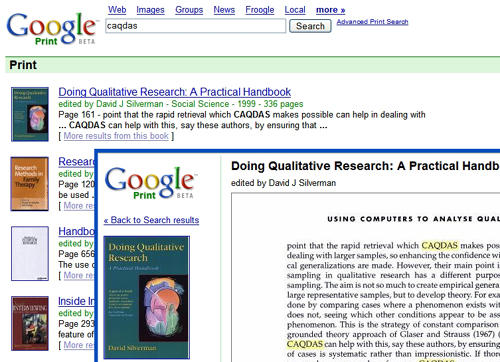 Utterly amazing. Welcome to the 21st century.
Burning Alexandria
It seems the Authors Guild has been admiring the MPIA and RIAA's strong-arm tactics and general unwillingness to adapt to new technological opportunities. According to CNET News, Google's Print Library Project is being sued for "massive copyright infringement," for its effort to digitize and permit full-text searches of books in the world's leading academic and public libraries.
As Google has pointed out, they have been quite careful to protect the rights of authors. GooglePrint users are only able to see 2-3 lines scanned from protected books, which hardly constitutes theft.
As Google has pointed out, they have been quite careful to protect the rights of authors. GooglePrint users are only able to see 2-3 lines scanned from protected books, which hardly constitutes theft.
Quantifying open-ended responses
From today's CONTENT listserv:
Pullman, McGuire, and Cleveland. 2005. "Let Me Count the Words: Quantifying Open-Ended Interactions with Guests." Cornell Hotel and Restaurant Administration Quarterly 46:3, p 323-43.
The authors demonstrate how to analyze responses to open-ended survey questions using software that supports content analysis and other linguistic analyses (WordStat). They also discuss various ways to analyze data, and compare these techniques with more traditional qualitative techniques for assessing responses to open-ended questions.
For those who haven't had the chance to try it out, WordStat (indeed, the entire Provalis suite) is an amazing program. Expensive, but amazing. Of course, there is the 30-day FREE trial...
Pullman, McGuire, and Cleveland. 2005. "Let Me Count the Words: Quantifying Open-Ended Interactions with Guests." Cornell Hotel and Restaurant Administration Quarterly 46:3, p 323-43.
The authors demonstrate how to analyze responses to open-ended survey questions using software that supports content analysis and other linguistic analyses (WordStat). They also discuss various ways to analyze data, and compare these techniques with more traditional qualitative techniques for assessing responses to open-ended questions.
For those who haven't had the chance to try it out, WordStat (indeed, the entire Provalis suite) is an amazing program. Expensive, but amazing. Of course, there is the 30-day FREE trial...
9.20.2005
Ctrl+S is your friend
I know there are lots of backup options out there (I use a 60G drive in a portable housing, Mike uses his iPod), but for those of you who haven't invested in portable storage, LaCie's Carte Orange 8G flash drive seems like a pretty cool deal.
According to the ad copy, it has the form factor of a credit card. Pretty friggin' cool.
According to the ad copy, it has the form factor of a credit card. Pretty friggin' cool.
Form follows data
For those puzzling over how to present their data, information aesthetics is a fascinating, daily blog of data visualization techniques.
It sometimes takes creativity to see how these could be adapted to social science, but I'm hooked.
It sometimes takes creativity to see how these could be adapted to social science, but I'm hooked.
Tufte, each yer heart out.
Thamus' curse*, redux
CNET News has a thought-provoking article on the potential effects of technology on human capacities. It's a VERY old idea, of course - but still quite relevant.
I tend to fall into Engelbart's side of the matter - while it's possible for these tools to make us weaker, I think that's only likely to happen if we fail to use them to expand our capabilities. Internal combustion helped make us (Americans) fatter, but it also expanded our horizons.
I would argue a similar dynamic is true of IT. If we only use it as a substitute for the real world, we'll turn into pudding cups. But if we push ourselves, expand our ability to work together, or increase the breadth and transparency of our knowledge, that's probably a good thing, no?
* From Plato's Phaedrus (translated by B Jowett)
I tend to fall into Engelbart's side of the matter - while it's possible for these tools to make us weaker, I think that's only likely to happen if we fail to use them to expand our capabilities. Internal combustion helped make us (Americans) fatter, but it also expanded our horizons.
I would argue a similar dynamic is true of IT. If we only use it as a substitute for the real world, we'll turn into pudding cups. But if we push ourselves, expand our ability to work together, or increase the breadth and transparency of our knowledge, that's probably a good thing, no?
* From Plato's Phaedrus (translated by B Jowett)
"At the Egyptian city of Naucratis, there was a famous old god, whose name was Theuth; the bird which is called the Ibis is sacred to him, and he was the inventor of many arts, such as arithmetic and calculation and geometry and astronomy and draughts and dice, but his great discovery was the use of letters. Now in those days the god Thamus was the king of the whole country of Egypt; and he dwelt in that great city of Upper Egypt which the Hellenes call Egyptian Thebes, and the god himself is called by them Ammon. To him came Theuth and showed his inventions ... It would take a long time to repeat all that Thamus said to Theuth in praise or blame of the various arts. But when they came to letters, This, said Theuth, will make the Egyptians wiser and give them better memories; it is a specific both for the memory and for the wit. Thamus replied: O most ingenious Theuth, the parent or inventor of an art is not always the best judge of the utility or inutility of his own inventions to the users of them. And in this instance, you who are the father of letters, from a paternal love of your own children have been led to attribute to them a quality which they cannot have; for this discovery of yours will create forgetfulness in the learners' souls, because they will not use their memories; they will trust to the external written characters and not remember of themselves. The specific which you have discovered is an aid not to memory, but to reminiscence, and you give your disciples not truth, but only the semblance of truth; they will be hearers of many things and will have learned nothing; they will appear to be omniscient and will generally know nothing; they will be tiresome company, having the show of wisdom without the reality."
9.19.2005
Post-doc: law and IT
Yale's Information Society Project offers a scholar-in-residence fellowship focusing on issues of law and technology. This year, they are keen on those interested in computer security, privacy issues, and development in the information age.
$37K +benefits, deadline is Feb 1 for the 2006-07 school year. More information can be found at the ISP website.
$37K +benefits, deadline is Feb 1 for the 2006-07 school year. More information can be found at the ISP website.
Use your camera phone as a scanner
New Scientist is reporting that NEC and NAIST have developed software that enables ordinary camera phones to take full-page document scans, and convert those scans into text, via optical character recognition (OCR).
WAY cool. It apparently has publishers in a tizzy, but this could be huge for researchers (and spies, I suppose). Imagine being able to email yourself full-text documents while doing archival work, or fieldwork generally.
To tell the truth though, I'd be happy with affordable, accurate, and high-speed digitizer and OCR technology. It might have helped me work through the thousands of pages of archival materials I brought back from my fieldwork.
WAY cool. It apparently has publishers in a tizzy, but this could be huge for researchers (and spies, I suppose). Imagine being able to email yourself full-text documents while doing archival work, or fieldwork generally.
To tell the truth though, I'd be happy with affordable, accurate, and high-speed digitizer and OCR technology. It might have helped me work through the thousands of pages of archival materials I brought back from my fieldwork.
Can there be an algorithm of justice?
Last week, The Boston Globe ran a story that proposed replacing judges with computers:
"But what if ''John Roberts" were not a human being but a piece of artificial intelligence software - a robot with the whole of law mapped out neatly in his circuit boards? Granted, the resulting Roberts-bot would not offer the personal charms of the wry, unflappably affable human Roberts. But consistency, predictability - surely those count for something."The premise has so many fundamental epistemological flaws, I don't really know where to begin. But I'd at least like to point out how these might shed light on the limits of the "originalist" (i.e., non-interpretive) position. I doubt even Justice Scalia would argue that he could - or should - be replaced by a computer program.
9.15.2005
Build datasets (a little) faster
For those who are not computer genuises, but still want to try an electronic approach to content analysis, you might want to try the Firefox extension downTHEMall. What it does is allow you to selectively, automatically download all links on a website to a local folder.
Say, for instance, that you wanted to perform a content analysis of GoogleNews reporting. Open your start page, then right-click. You then have the option of filtering out certain URLs (e.g., those containing the strings "google" or ".net"), then automatically saving the others.
It's not the perfect solution, but it might be easier (and quicker) for some of you than learning Perl or Java.
Kudos to Shanna for the tip.
Say, for instance, that you wanted to perform a content analysis of GoogleNews reporting. Open your start page, then right-click. You then have the option of filtering out certain URLs (e.g., those containing the strings "google" or ".net"), then automatically saving the others.
It's not the perfect solution, but it might be easier (and quicker) for some of you than learning Perl or Java.
Kudos to Shanna for the tip.
9.14.2005
Making the link
The latest issue of Connections (26:2) is out. Articles include:
"Social Network Analysis and Estimating the Size
of Hard-to-Count Subpopulations" (Jackson etal)
"Complete Network Analysis in Research of
Organized Interests and Policy Analysis" (Real and Hasanagas)
"Connecting the Dots without Forgetting the
Circles" (Wolfe)
"Social Network Analysis and Estimating the Size
of Hard-to-Count Subpopulations" (Jackson etal)
"Complete Network Analysis in Research of
Organized Interests and Policy Analysis" (Real and Hasanagas)
"Connecting the Dots without Forgetting the
Circles" (Wolfe)
9.13.2005
Census maphack
It might not be terribly useful for research, but someone at AnalyGIS and SRC has put together a hack that integrates 2000's Census and Housing Report into a clickable GoogleMaps inteface.
Might be useful for classroom purposes (e.g., on-the-fly calculations).
Might be useful for classroom purposes (e.g., on-the-fly calculations).
9.12.2005
e-Fellowships
Britain's National Centre for e-Social Science has 1-6 month fellowships available for scholars interested in exploring how e-science could facilitate your own research.
Fellowships are not restricted to UK residents, and may possibly include transportation allowances. Check out NCeSS' website for more details.
Fellowships are not restricted to UK residents, and may possibly include transportation allowances. Check out NCeSS' website for more details.
Webcasts on games and teaching
Innovate, the journal of online education, is hosting a series of webcasts over the next week, focusing on games as a pedagogical tool:
"Game-Informed Learning: Applying Computer Game Processes to Higher Education" Sept 13th, 2005 12:00pm ET
"Epistemic Games" Sept 20th, 2005 12:00pm ET
"Changing the Game: What Happens When Video Games Enter the Classroom?" Sept 20th, 2005 4:00pm ET
You'll need to register, but it's FREE.
"Game-Informed Learning: Applying Computer Game Processes to Higher Education" Sept 13th, 2005 12:00pm ET
"Epistemic Games" Sept 20th, 2005 12:00pm ET
"Changing the Game: What Happens When Video Games Enter the Classroom?" Sept 20th, 2005 4:00pm ET
You'll need to register, but it's FREE.
9.09.2005
Ariadne's jurisprudence
I missed this when it first came out, but an article in the August 25th edition of The Economist describes Seth Chandler's (U Houston Law) recent Mathematica paper, as well as work by Fowler and Jeon (UC Davis) on the social network analysis of law. Both of these neatly dovetail with CITE-IT, an NSF-funded project here UMaryland's Department of Government and Politics.
Networks, networks everywhere.
Networks, networks everywhere.
More network analysis of the courts
Stan Wasserman (yes, that Stan Wasserman), writing in the online journal Centrality, describes a project that he's been working on with Doug Steinley (U Missouri) to analyze the Rehnquist Court as an affiliation network.
"Each case is an affiliation variable, containing recorded information on which justice voted in the affirmative. So, if there have been 100 cases decided in a given year, the data array consists of a 9 by 100 two-dimensional matrix which gives all the affirmative votes, case-by-case, on each and every case."Wasserman hopes to use this data to identify stable "liaisons" between justices.
9.08.2005
An epistle from nerd camp
In case you missed it, last week APSA held its annual uber meeting here in DC. The faint of heart seemed content to jeer from the sidelines, including a $100 bounty for a picture of Prof Cornell West "scarfing down a jumbo slice."
Who says nerds can't have a little fun? I had a BLAST at the methodology panels (really).
According to the DCist, the challenge was met.
Who says nerds can't have a little fun? I had a BLAST at the methodology panels (really).
Online community
The latest issue of the Journal of Computer- Mediated Communication (10:4) focuses on just that topic. Articles include:
"Community Networks: Where Offline Communities Meet Online" (Kavanaugh, Carroll, et al)
"Debating the Events of September 11th: Discursive and Interactional Dynamics in Three Online Fora" (Robinson)
"Picturing Usenet: Mapping Computer-Mediated Collective Action" (Combs Turner, Smith, et al)
"Community Networks: Where Offline Communities Meet Online" (Kavanaugh, Carroll, et al)
"Debating the Events of September 11th: Discursive and Interactional Dynamics in Three Online Fora" (Robinson)
"Picturing Usenet: Mapping Computer-Mediated Collective Action" (Combs Turner, Smith, et al)
Back to the source
The University of North Carolina has recently made the full archives of The Technology Source (1997 -2003) publicly available. Written by and for educators, TTS was a peer-reviewed, online journal focused on the challenges and opportunities that information technologies pose for educators.
A few to whet your appetites:
"Simulations and the Learning Revolution: An Interview with Clark Aldrich" (James L Morrison)
"RSS: The Next Killer App For Education" (Mary Harrsch)
"Taking Technology to the Classroom: Pedagogy-Based Training for Educators" (David P Diaz)
Let the browsing begin.
A few to whet your appetites:
"Simulations and the Learning Revolution: An Interview with Clark Aldrich" (James L Morrison)
"RSS: The Next Killer App For Education" (Mary Harrsch)
"Taking Technology to the Classroom: Pedagogy-Based Training for Educators" (David P Diaz)
Let the browsing begin.
It's training time again...
Boston-based SdG Associates are holding a new group of ATLAS.ti, NVIVO, and N6 trainings this November. It's not cheap ($325-600 for educators), but given that these programs are both quite sophisticated and "somewhat beyond" what typically falls under methodological training in the US, it could well be worth the money.
9.07.2005
Responding to Katrina
FYI: there is a large, uncoordinated effort in academia as a whole to accomodate the students and faculty whose lives were disrupted by hurricane Katrina and its aftermath.
Here's an excellent example of an innovative use of the new technologies: the RTS Center for Latin American Studies at Tulane has re-tasked its blog to help students and faculty find temporary homes while New Orleans recovers.
Here's an excellent example of an innovative use of the new technologies: the RTS Center for Latin American Studies at Tulane has re-tasked its blog to help students and faculty find temporary homes while New Orleans recovers.
Vision
Phillips Technology appears to have beaten its competitors in bringing electronic paper to market. Their "startup" company Polymer Vision had working demos at the Internationale Funkausstellung (IFA) consumer products fair in Berlin last week.
This is one of those seemingly minor technologies that could have revolutionary effects across a range of industries. Ubiquitous computing is now closer to reality than ever.
This is one of those seemingly minor technologies that could have revolutionary effects across a range of industries. Ubiquitous computing is now closer to reality than ever.
The Interweb, IR, and politics
The European Information Network on International Relations and Area Studies is holding its conference on the Evolution of the Internet and the Study of IR and Political Science next week (Sept 14-16) in Zurich.
The full program is available here. Highlights include:
"From Lenin to Hedgehog Heavyweights and Foxy Artists: Social Network Analysis' Political Past and Scientific Future" (van Meter)
"The Evolution of the Internet and the Study of IR and Political Science" (Weber)
It appears to be too late to register, but those interested might try contacting the IR and Security Network Chief Editor, Chris Pallaris.
The full program is available here. Highlights include:
"From Lenin to Hedgehog Heavyweights and Foxy Artists: Social Network Analysis' Political Past and Scientific Future" (van Meter)
"The Evolution of the Internet and the Study of IR and Political Science" (Weber)
It appears to be too late to register, but those interested might try contacting the IR and Security Network Chief Editor, Chris Pallaris.
Don't MITH this...
The Maryland Institute for Technology in the Humanities is beginning its brown bag series this fall with a presentation by Silvia Mejía on Sept 13th, from 12:30-2pm (B0135 McKeldin library).
Mejía will show portions of a documentary that investigates how the Internet, satellites, email, video-conferencing and cell phones have changed life for those far from home.
Mejía will show portions of a documentary that investigates how the Internet, satellites, email, video-conferencing and cell phones have changed life for those far from home.
9.06.2005
The Demise of Public Domain
The September/October issue of Foreign Policy includes a letter by Lawrence Lessig (Stanford Law) on the gradual, not-so-subtle destruction of the concept of "public domain" rights.
The rationale for the private domain has always been that it creates incentives to create and produce. When those protections were attached to individuals, there was a natural transition point between private interest and fair public use. But as these became attached to corporations (treated as individuals under American law), the concept of obsolescence has no such simple boundary.
According to Prof Lessig, we now risk the possibility that the means of sustaining and vitalizing our culture will rest almost solely in commercial hands. A sobering thought, indeed.
The rationale for the private domain has always been that it creates incentives to create and produce. When those protections were attached to individuals, there was a natural transition point between private interest and fair public use. But as these became attached to corporations (treated as individuals under American law), the concept of obsolescence has no such simple boundary.
According to Prof Lessig, we now risk the possibility that the means of sustaining and vitalizing our culture will rest almost solely in commercial hands. A sobering thought, indeed.
The 411 on comp linguistics
Folks at the University of Zurich have put together a Computational Linguistics FAQ page. Though it's a bit biased towards the German language, on the whole it's straightforward, well-organized, and has oodles of additional references.
9.05.2005
Beyond typewriters, adding machines
Ahem. A moment of shameless self-promotion:
Cousins, K and W McIntosh (2005). "More than Typewriters, More than Adding Machines: Integrating Information Technology into Political Research." Quality & Quantity 39: 581-614.
It's already quite dated (funny story, there), but the broad outlines are still valid. We'd be very interested in hearing the ideas, opinions, or experiences of others - please feel free to contact us at the email given in the paper.
Cousins, K and W McIntosh (2005). "More than Typewriters, More than Adding Machines: Integrating Information Technology into Political Research." Quality & Quantity 39: 581-614.
It's already quite dated (funny story, there), but the broad outlines are still valid. We'd be very interested in hearing the ideas, opinions, or experiences of others - please feel free to contact us at the email given in the paper.
Learning by doing
I had the great fortune to come across a copy of Exploratory Social Network Analysis with Pajek by Wouter de Nooy, Andrej Mrvar, Vladimir Batagelj, and Mark Granovetter at the APSA Annual Conference in DC this past week.
Since I'm not much for cocktail talk, I spent downtime between panels reading this excellent text. Written as a hands-on overview of SNA, it combines clear, relatively jargon-free descriptions of the network paradigm with step-by-step practical exercises. Both software and datasets are FREE through the book's website.
I read most of the first three chapters at the conference, but I can't wait to start over with the software and data.
It may be the best-designed methods text I've ever seen. Kudos to de Nooy and team!
Since I'm not much for cocktail talk, I spent downtime between panels reading this excellent text. Written as a hands-on overview of SNA, it combines clear, relatively jargon-free descriptions of the network paradigm with step-by-step practical exercises. Both software and datasets are FREE through the book's website.
I read most of the first three chapters at the conference, but I can't wait to start over with the software and data.
It may be the best-designed methods text I've ever seen. Kudos to de Nooy and team!
Late again
Well, the September issue of First Monday came out last week, and I missed it. Some very interesting articles this time:
- Brian Still, on Hacking for a cause
- Steve Jones and Camille Johnson–Yale, on Professors online
- Maureen Minielli and S Pixy Ferris, on Electronic courseware
Social Policy Research Assoc are hiring
According to the announcement in Idealist.org, SPRA is looking for a full-time qualitative researcher (English and Spanish fluency) to conduct interview, focus-group, and survey research, analyzing those results for governmental and non-profit clients.
Requires a social science graduate degree, salary based on experience. Last day to apply is October 31st. See their website for further details.
Requires a social science graduate degree, salary based on experience. Last day to apply is October 31st. See their website for further details.
Subscribe to:
Posts (Atom)