10.29.2005
Qualitative research methods
This one's been out there a few months, but if you haven't checked out Stephen Gourlay's summary on Research@KH, you should.

Conference podcasts from Learning2005
I guess this means we're witnesses to a zeitgist. Learning 2005, a conference being held in Orlando from Oct 30-Nov 2, is also offering free podcasts (and transcripts) of presentations.
My fav: Masie's podcast on "How to Podcast" (pdf)
My fav: Masie's podcast on "How to Podcast" (pdf)
Interpreting graphic info
For anyone in the College Park area this Halloween from 2-3:30pm, UM's Center for Teaching Excellence is hosting a talk on How To Help Students Read and Interpret Graphic Information.
10.28.2005
NUD*IST review
A few weeks ago, the blog Gender & IT Design had a brief, but interesting review of the CAQDAS software NUD*IST from a novice's perspective.
Worth a look, for those new to this sort of thing.
Worth a look, for those new to this sort of thing.
Clinical trial for gender bias
According to Erika Check, writing in this week's issue of the journal Nature, researchers at Baylor College of Medicine are in the middle of clinical trials that enable couples to pick the gender of their fetus, to test for "social effects."
Eww.
Eww.
Establishing your boundaries
For those of you who work on American politics research where spatial distribution is relevant, Maps.Huge.Info may be a useful tool. A mashup of GoogleMaps with zip code, county, and municipal boundary data, the interface is very intuitive and easy to use, offering all the controls of GoogleMaps (e.g., zoom, pan, center).
To find all the county or zip code boundaries for a given area (e.g., a state), just click on the map.
It's not ArcView, but it could be useful for quick reference and classroom tasks.
To find all the county or zip code boundaries for a given area (e.g., a state), just click on the map.
It's not ArcView, but it could be useful for quick reference and classroom tasks.
APSA CFP ASAP
A reminder - the Call for Papers deadline for APSA's 2006 Meeting in Philly (sadly, we lost San Francisco) is November 15th.
I've never really understood why they have "themes" for these, but next year's is "Power Reconsidered."
Maybe it's to make the t-shirts more collectible.
I've never really understood why they have "themes" for these, but next year's is "Power Reconsidered."
Maybe it's to make the t-shirts more collectible.
10.27.2005
10.26.2005
Tourists to get chip implants
Well, actually our passports will. CNET News is reporting about State Department regulations issued yesterday. After October 2006, all US passports will be embedded with RFID chips that include info such as: name, age, date of birth and a digital photo, with the possibility that fingerprints or retinal scans might be included at a later date.
What - no photos of the back your head?
What - no photos of the back your head?
Politics and the Interweb
Karen Jagoda, President of the e-Voter Institute and long-time Internet consultant, has just published Crossing the River: The Coming of Age of the Internet in Politics and Advocacy.
From the jacket:
From the jacket:
The political process is seeing the impact of disruptive technologies that are leading to dramatic changes in the marketplace of ideas and action. ... The focus of this collection of provocative essays and research from a broad range of leading political online strategists and Republican and Democratic insiders is on the most effective use of online tools in order to better allocate valuable campaign resources.
10.25.2005
Which streetlamp did you look under?
The metasearch engine Dogpile has implemented a simple but fascinating demonstration of why we shouldn't rely on only Google (or MSN or Yahoo! or Ask Jeeves) when searching out the little nooks and crannies of the Interweb.
 Oh yeah, it also produces search results
for all of these engines.
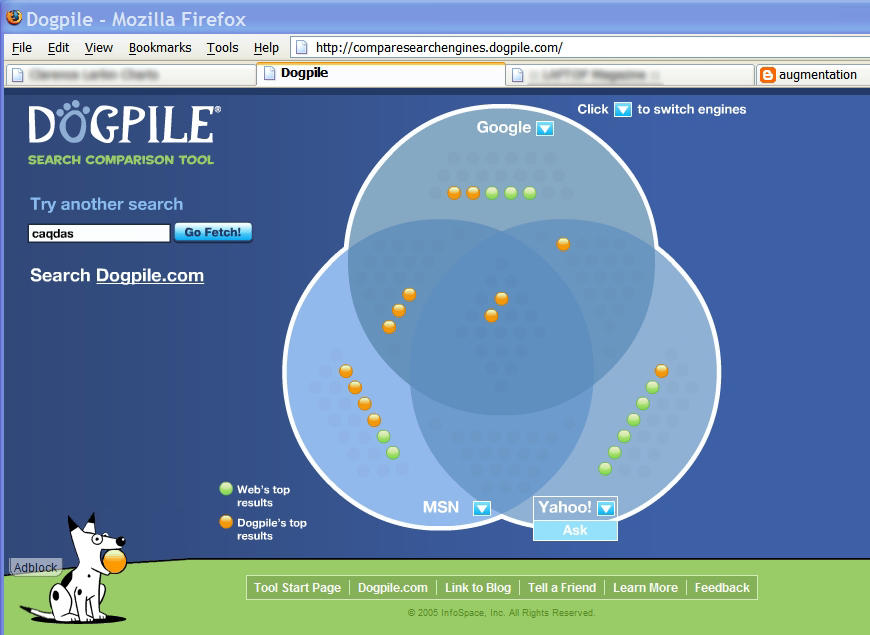 Oh yeah, it also produces search results
for all of these engines.
Stanford podcasts
Stanford University has teamed up with Apple to offer Stanford iTunes, free mp4 (Apple encoding) files of faculty lectures, books, discussions on global issues, and more.
On a parallel note, Newsday is reporting that Purdue, Drexel, Allegheny, and other colleges and universities are beginning to offer lectures in podcast form, for students who miss class.
Addendum - The latest issue of EDUCAUSE has an article by Gardner Campbell: "There’s Something in the Air: Podcasting in Education"
On a parallel note, Newsday is reporting that Purdue, Drexel, Allegheny, and other colleges and universities are beginning to offer lectures in podcast form, for students who miss class.
Addendum - The latest issue of EDUCAUSE has an article by Gardner Campbell: "There’s Something in the Air: Podcasting in Education"
10.21.2005
Portable whiteboards
The folks over at Lifehacker have discovered the wonders of static-cling mylar. These plastic sheets attach themselves to most any surface, and are useful not only for quick visualization, but if you attached them more permanently (I use thumbtacks), they provide a nice protective surface suitable for writing or taping or fun tac.
It keeps building maintenance off my back, but allows me to "paper" my office walls with things I need to remember from one chapter to the next.
Yes, I am a geek.
It keeps building maintenance off my back, but allows me to "paper" my office walls with things I need to remember from one chapter to the next.
Yes, I am a geek.
Governing the Interweb
Andy Oram has an interesting essay on O'Reillynet.com, explaining why control over Internet maintenance tasks (e.g., assigning domain names and IP addresses) is such a political issue. Short story: the UN has proposed taking over these duties from ICANN (based in the US of A), and it looks like JB don't play that.
You probably haven't seen anything about it on the nightly news, what with all those naked coeds stories. But trust me, this is a big deal.
You probably haven't seen anything about it on the nightly news, what with all those naked coeds stories. But trust me, this is a big deal.
10.19.2005
Evolve or die? Just sue!
The Association of American Publishers announced today that they are also suing GooglePrint for copyright infringement. As anyone who's spent more than five minutes on GooglePrint can easily tell, the technology is very controlled, and more likely to result in more books being sold, rather than fewer.
Addendum: The Scholarly Electronic Publishing Weblog has put together a comprehensive bibliography of the GooglePrint controversy.
Addendum: The Scholarly Electronic Publishing Weblog has put together a comprehensive bibliography of the GooglePrint controversy.
10.18.2005
No anonymity for you!
According to Sofia Celeste, writing in the Christian Science Monitor, anyone using a public-access Interweb connection in Italy will now be required to submit a passport first.
Meant as an anti-terror provision, I'll bet it really cuts down on porn (office safe), as well.
Meant as an anti-terror provision, I'll bet it really cuts down on porn (office safe), as well.
Spatial reporting
One of the more interesting GoogleMaps mashups is WeReporters GeoNews, which situates GoogleNews reports geographically - in live time.
Everytime a new story is added, GeoNews scrolls to the location and adds an (optional) pop-up summary.
Very cool. Could be the best screensaver ever.
Everytime a new story is added, GeoNews scrolls to the location and adds an (optional) pop-up summary.
Very cool. Could be the best screensaver ever.
A healthy, bouncing patent infringement!
Kyle Jensen and Fiona Murray published an article in the journal Science this week that claims that 20% of human gene sequences have been patented.
Again - when do we know we've gone too far?
Again - when do we know we've gone too far?
10.14.2005
Keep up-to-date with RSS feeds
Add GoogleReader to the ton of RSS readers floating about the world. I've only played with it a short while, but I'm hooked. It combines much of the functionality of gmail (labels, searches) with a very easy interface for adding new feeds.
Grooviness.
Grooviness.
10.10.2005
T-LAB Tools for Text Analysis
I haven't tried this yet, but it looks very useful for hybrid quantitative linguistic/qualitative content analysis research designs, perhaps in the vein of Provalis' suite of qual/quant utilities (QDA Miner, SimStat, and WordStat).
10.05.2005
Get your research on
The International Center for Qualititative Inquiry at Urbana-Champaign has just issued a call-for-papers for the 2nd International Congress of Qualitative Inquiry, May 4-6, 2006.
Around the theme of "Ethics, Politics and Human Subject Research," they're looking for papers on topics such as: academic freedom, ethics and IRBs; alternative IRB models; developments in Participatory Action Research; grounded theory and social justice research; and so much more.
Submissions deadline is December 1st. See their website for further details.
Around the theme of "Ethics, Politics and Human Subject Research," they're looking for papers on topics such as: academic freedom, ethics and IRBs; alternative IRB models; developments in Participatory Action Research; grounded theory and social justice research; and so much more.
Submissions deadline is December 1st. See their website for further details.
LexisNexis launches MarketImpact
Enormous potential for the study of media and politics.
Addendum (from Ken): I found a live link to a press release describing MarketImpact functionality. They're clearly sucking up to the "brand management" types, but you're right Mike - the tool could be used for good, as well.
Addendum (from Ken): I found a live link to a press release describing MarketImpact functionality. They're clearly sucking up to the "brand management" types, but you're right Mike - the tool could be used for good, as well.
10.04.2005
Alexandria, redux
Turns out, Google's not the only search service interested in indexing the big ol' world o' books. Yesterday, USA Today reported that Yahoo! will begin a parallel project. The key difference (aside from the paranoid lawsuits that have cropped up around GooglePrint) is that Yahoo! plans to limit its efforts to public domain literature.
10.03.2005
Free online collaborative software
The folks at 37signals just released the web-based text editor Writeboard. As with other word processors, Writeboard tracks changes and can compare documents across edits. The really nifty trick (aside from being web-based) is the version journal that allows users to revisit any previous edit (identified by time and user).
The blame game
This week's New York Times Week in Review included a graphical network by Bill March of the various claims (and counterclaims) of fault for the failures of the Katrina response.
Leaving aside the actual content, this is a fascinating way to represent relationships between actors. Granted, at ten nodes, it appears to be near the limits of intelligibility - but I can see how approaches like this could be useful for portraying a whole range of social dynamics.
By the way, if you find this sort of thing interesting, I highly recommend you look at Mark Lombardi's work.

Leaving aside the actual content, this is a fascinating way to represent relationships between actors. Granted, at ten nodes, it appears to be near the limits of intelligibility - but I can see how approaches like this could be useful for portraying a whole range of social dynamics.
By the way, if you find this sort of thing interesting, I highly recommend you look at Mark Lombardi's work.
Subscribe to:
Posts (Atom)