Decision Explorer might be useful for qualitative researchers and possibly even for game/decision theorists. The developer, Banxia, describes it as a "tool for managing "soft" issues - the qualitative information that surrounds complex or uncertain situations. It allows you to capture in detail thoughts and ideas, to explore them, and gain new understanding and insight. The result is a fresh perspective, and time saved through increased productivity, release of creativity and a better focus".
Tags: CAQDAS, qualitative research
11.22.2005

11.21.2005
Qual Interest Group conf
Reminder: the 19th Annual Conference on Interdisciplinary Qualitative Studies will be held this coming January 6-8, at the Georgia Center For Continuing Education, in Athens, Georgia.
The theme is "Local knowledge, global contexts: Mapping the terrain of qualitative research in the 21st Century." Topics include: new means to generate, analyze and represent data; research partnerships; ethics of research; and much more.
Register online by December 1st ($65 for students).
The theme is "Local knowledge, global contexts: Mapping the terrain of qualitative research in the 21st Century." Topics include: new means to generate, analyze and represent data; research partnerships; ethics of research; and much more.
Register online by December 1st ($65 for students).
11.18.2005
Knowledge Navigator
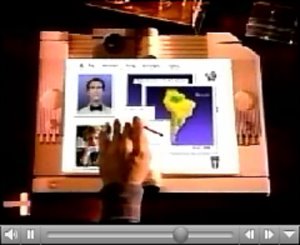
Fascinating. Jeremy Douglas (Writer Response Theory) has just put up a fascinating post on the Legal Machines Project. In it, he references an Apple video from the 1980s, Knowledge Navigator. It's very low res, but I guarantee it will provide plenty of food for thought.
 Anyone know any more details about this project? Who was working on it then, and where are they now?
Tags: visualization, teaching
 Anyone know any more details about this project? Who was working on it then, and where are they now?
Tags: visualization, teaching
Google Advanced Operators
Nancy Blachman at GoogleGuide has put together an amazing Quick Reference Cheat Sheet to Google's advanced operators.
For instance, if you want to to find only pdf documents about CAQDAS, type:
"google reference filetype:pdf CAQDAS"
Groovy.
Tags: search
For instance, if you want to to find only pdf documents about CAQDAS, type:
"google reference filetype:pdf CAQDAS"
Groovy.
Tags: search
Call for papers
dg.o2006, the NSF-sponsored 7th Annual Conference on Digital Government, will be held next May 21-24th, in San Diego, CA.
Described as "a forum for the presentation and discussion of interdisciplinary research on digital government and its applications in diverse domains," the conference will focus on: research at the intersections of computing research, social, political, and behavioral science research; and partnerships of university researchers and government.
Deadline for submission is December 5th.
Described as "a forum for the presentation and discussion of interdisciplinary research on digital government and its applications in diverse domains," the conference will focus on: research at the intersections of computing research, social, political, and behavioral science research; and partnerships of university researchers and government.
Deadline for submission is December 5th.
Constitutional Convention, redux
The Library of Congress has now digitized over 250 documents from that historical era (1774-89).
See the "originals" without leaving your desk.
Tags: data, publications
See the "originals" without leaving your desk.
Tags: data, publications
11.16.2005
Choosing a CAQDAS Package
A third edition of the working paper titled "Choosing a CAQDAS Package" is available online via the CAQDAS Networking Project.
New to the third edition is coverage of recently released software packages QDA Miner and Transana.
Tags: CAQDAS, audio, content analysis, text mining
New to the third edition is coverage of recently released software packages QDA Miner and Transana.
Tags: CAQDAS, audio, content analysis, text mining
Total traffic awareness
From the stranger than fiction files - according to The Register, it seems the UK has begun building a "national vehicle movement database" that tracks every car on every highway every hour of every day.
The system uses cameras and software that can recognize plate numbers, linking them to databases of insurance coverage and vehicle taxes.
It's like Sim City, with a little 1984 thrown in.
Tags: privacy, security
The system uses cameras and software that can recognize plate numbers, linking them to databases of insurance coverage and vehicle taxes.
It's like Sim City, with a little 1984 thrown in.
Tags: privacy, security
11.15.2005
Program on Networked Governance
The KSG announced the web-portal to their new Program on Networked Governance yesterday:
"The traditional notion of hierarchical, top down, government has always been an imperfect match for the decentralized governance system of the US. However, much of what government does requires co-production of policy among agencies that have no formal authority over each other, fundamentally undermining the traditional Weberian image of bureaucracy. Networked governance refers to a growing body of research on the interconnectedness of essentially sovereign units, which examines how those interconnections facilitate or inhibit the functioning of the overall system. The objective of this program is two-fold: (1) to foster research on networked governance and (2) to provide a forum to discuss the challenges of networked governance."
Also: check out their blog.
Tags: governance, networks
"The traditional notion of hierarchical, top down, government has always been an imperfect match for the decentralized governance system of the US. However, much of what government does requires co-production of policy among agencies that have no formal authority over each other, fundamentally undermining the traditional Weberian image of bureaucracy. Networked governance refers to a growing body of research on the interconnectedness of essentially sovereign units, which examines how those interconnections facilitate or inhibit the functioning of the overall system. The objective of this program is two-fold: (1) to foster research on networked governance and (2) to provide a forum to discuss the challenges of networked governance."
Also: check out their blog.
Tags: governance, networks
11.14.2005
Technology Archives
Although Technology Source stopped publishing in 2003, many of its articles are still quite relevant. Now that UNC has made the archives available, you can search or browse your way to e-bliss.
A couple of nuggets:
Jackson, 1997. Use of PowerPoint in Teaching Comparative Politics
Ralston, 1998. The Art and Science of Education:
Pedagogy Includes Technology
Tags: publications, teaching
A couple of nuggets:
Jackson, 1997. Use of PowerPoint in Teaching Comparative Politics
Ralston, 1998. The Art and Science of Education:
Pedagogy Includes Technology
Tags: publications, teaching
11.11.2005
Qualitative Inquiry
The 2nd International Congress of Qualitative Inquiry (May 3-6, 2006) has announced a Call for Papers:
"The theme of the Second International Congress, "Ethics, Politics and Human Subject Research" builds on and extends the theme of the First International Congress which focused on "Qualitative Inquiry in a Time of Global Uncertainty." The 2006 Congress will explore experiences with and criticisms of Institutional Review Boards. It will question the over-reliance of audit cultures on evidence-based, neo-experimental models of inquiry. The 2006 Congress will investigate new ways of decolonizing traditional methodologies. It will take up performative, feminist, indigenous, democratic and participatory forms of critical inquiry. The 2006 Congress will examine how these new forms of inquiry can advance the goals of social justice and progressive politics in this new century."
Deadline for abstracts is December 1st.
"The theme of the Second International Congress, "Ethics, Politics and Human Subject Research" builds on and extends the theme of the First International Congress which focused on "Qualitative Inquiry in a Time of Global Uncertainty." The 2006 Congress will explore experiences with and criticisms of Institutional Review Boards. It will question the over-reliance of audit cultures on evidence-based, neo-experimental models of inquiry. The 2006 Congress will investigate new ways of decolonizing traditional methodologies. It will take up performative, feminist, indigenous, democratic and participatory forms of critical inquiry. The 2006 Congress will examine how these new forms of inquiry can advance the goals of social justice and progressive politics in this new century."
Deadline for abstracts is December 1st.
11.10.2005
Conference on e-Social Science
The UK's ESRC National Centre for e-Social Science has just announced a Call for Papers for next year's Second International Conference on e-Social Science:
The conference will be held June 28-30th 2006 at Manchester Metropolitan University.
"We invite contributions from members of the social science and Grid research communities with experience of - or interests in - exploring, developing and applying e-Social Science research methods, practices and tools, and in studying the wider development of e-Research and the Grid."
Deadline for abstracts and outlines is January 23rd, 2006.
Tags: conference
The conference will be held June 28-30th 2006 at Manchester Metropolitan University.
"We invite contributions from members of the social science and Grid research communities with experience of - or interests in - exploring, developing and applying e-Social Science research methods, practices and tools, and in studying the wider development of e-Research and the Grid."
Deadline for abstracts and outlines is January 23rd, 2006.
Tags: conference
NetSci 2006
Next May, Indiana University at Bloomington will host a NetSci 2006, a 5-day workshop and 4-day conference on Network Science:
"The International Workshop and Conference on Network Science will bring together leading researchers and practitioners in network science - analysts, modeling experts, and visualization specialists with graduate students from many different research areas for interdisciplinary communication and collaboration.
Tags: conference, networks
"The International Workshop and Conference on Network Science will bring together leading researchers and practitioners in network science - analysts, modeling experts, and visualization specialists with graduate students from many different research areas for interdisciplinary communication and collaboration.
The primary objective of the Workshop/Conference is to facilitate interactions between social and behavioral scientists and the many other disciplines interested in and utilizing network science.
The event will be held over a two week period at Indiana University, Bloomington, Indiana, during May 2006. The first week, the Workshop, will feature tutorials (which present basic, educational material) focusing on a variety of network science research areas. It aims to present and support experimental, theoretical and applied network research by educating the research community on standard network data, tools, and powerful computational resources. The Conference comprises talks by social and behavioral scientists, information scientists, biologists, statistical physicists, mathematicians and statisticians."
Tags: conference, networks
Open-source annotation
According to Plasticbag.org, the BBC is experimenting with wiki-style annotation of its enormous library of audio files.
Reliability issues aside, how might this be considered as a method of historical research? After all, categorizing is theorizing.
Tags: audio, open_source, tagging
Reliability issues aside, how might this be considered as a method of historical research? After all, categorizing is theorizing.
Tags: audio, open_source, tagging
11.09.2005
Find open license materials with Google
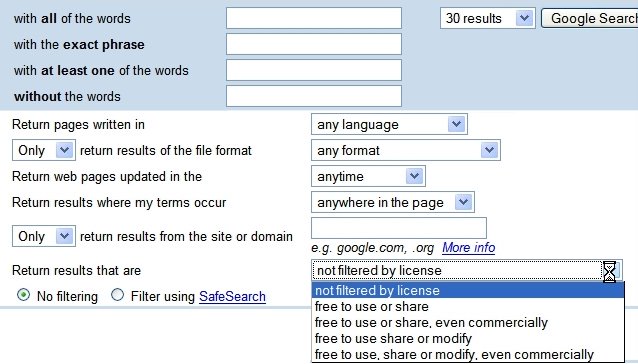
For projects where copyright may be an issue, try the new feature of Google Advanced Search that filters results by licensing limitations.
CAQDAS and standard statistical packages
This came across the CONTENT listserv this morning (reproduced with permission):
>>>I am looking to compare the following programs SPSS, Nud*ist, ATLAS, and, SAS...
First, let me say that your list included two very different kind of computer programs. SAS and SPSS have comparable features and are designed for hard-core statistical analysis of quantitative data. At least one of them, I do not recall which, has some text processing capabilities but that is not its primary purpose.
The other two on the list are examples of the many different versions of computer assisted qualitative analysis software, or CAQDAS, that are available. And to answer that part of your question, there are a variety of different sources where you can compare the different versions, download trial copies, and so on.
CAQDAS Networking Project
CAQDAS Primer
SAS and SPSS are very similar programs. Other than some interface peculiarities, they both do essentially the same thing and choice is generally based on what's available at the institution where one works.
The various qualitative analysis software programs are, on the other hand, much more idiosyncratic with a wide variety of different capabilities and approaches. There are some standard capabilities (e.g. coding and memoing). This may represent a field that is still developing or it may represent the very nature of the intellectual pursuit of qualitative analysis itself.
Elliot Richmond, Ph.D.
Tags: CAQDAS, content analysis, qualitative research
>>>I am looking to compare the following programs SPSS, Nud*ist, ATLAS, and, SAS...
First, let me say that your list included two very different kind of computer programs. SAS and SPSS have comparable features and are designed for hard-core statistical analysis of quantitative data. At least one of them, I do not recall which, has some text processing capabilities but that is not its primary purpose.
The other two on the list are examples of the many different versions of computer assisted qualitative analysis software, or CAQDAS, that are available. And to answer that part of your question, there are a variety of different sources where you can compare the different versions, download trial copies, and so on.
CAQDAS Networking Project
CAQDAS Primer
SAS and SPSS are very similar programs. Other than some interface peculiarities, they both do essentially the same thing and choice is generally based on what's available at the institution where one works.
The various qualitative analysis software programs are, on the other hand, much more idiosyncratic with a wide variety of different capabilities and approaches. There are some standard capabilities (e.g. coding and memoing). This may represent a field that is still developing or it may represent the very nature of the intellectual pursuit of qualitative analysis itself.
Elliot Richmond, Ph.D.
Tags: CAQDAS, content analysis, qualitative research
CAQDAS and you
Folks in the Dept of Social Sciences at Loughborough U have put together a trove on Computer-Assisted Qualitative Data Analysis Software. For those new to such approaches, their Primer offers a detailed overview and a comparison of the major software packages.
Probably the single best source of information on this topic.
Tags: CAQDAS, qualitative research
Probably the single best source of information on this topic.
Tags: CAQDAS, qualitative research
Day after the day after the First Monday
I guess it's that time again - a new First Monday is out. Political scientists might find the article by Noveck's piece on "A democracy of groups" interesting, political economists might like Garner etal's article "Online images of industrialization in the American Midwest," and everyone should benefit from reading Kim and Moore's essay "Web-based learning: factors affecting students' satisfaction and learning experience."
Happy reading.
Tags: publications, teaching
Happy reading.
Tags: publications, teaching
11.08.2005
Agent-based network modeling
It seems both of these approaches are going gangbusters these days. NetLogo is a FREE program environment that supports integrated agent-based and network modeling. There are plenty of existing models for a WIDE variety of applications.
Because you always wanted to know.
Tags: modeling, networks, FREE
Because you always wanted to know.
Tags: modeling, networks, FREE
11.02.2005
More academic podcasts
The blog Productive Strategies has compiled a number of free academic podcasts. Several more appear in the comments sections at the bottom.
Survey of Global History - Purdue
Introduction to International Relations - Purdue
Intro to American Politics - U Washington
Tools for the Information Age - U Hawaii
Understanding Computers and the Internet - Harvard
Intro to computers - UC Berkeley
Also, Princeton's University Channel has TONS of lectures in a variety of formats (e.g., streaming audio, video, mp3).
You may also want to try the online service offered by blinkx, which monitors over 15,000 podcasts and vlogs (video blogs) with a voice-recognition ap.
ADDENDUM: Mangolab has a nice tutorial on how to add RSS/XML podcast feeds to iTunes. Of course, for mp3 files, just right-click and save.
Tags: podcasts, teaching
Survey of Global History - Purdue
Introduction to International Relations - Purdue
Intro to American Politics - U Washington
Tools for the Information Age - U Hawaii
Understanding Computers and the Internet - Harvard
Intro to computers - UC Berkeley
Also, Princeton's University Channel has TONS of lectures in a variety of formats (e.g., streaming audio, video, mp3).
You may also want to try the online service offered by blinkx, which monitors over 15,000 podcasts and vlogs (video blogs) with a voice-recognition ap.
ADDENDUM: Mangolab has a nice tutorial on how to add RSS/XML podcast feeds to iTunes. Of course, for mp3 files, just right-click and save.
Tags: podcasts, teaching
11.01.2005
Expand your desktop real estate
Disambiguation
Yes, it sounds like something from the Simpsons, but it's a real word used to describe the problem of deriving semantic meaning from lexical cues. Of course, if you're a computational linguist, you already know this. But if you aren't, and this still seems interesting, check out the Making Sense of Sense: Bringing Computation Linguistics and Psycholinguistics Together workshop at this 11th Annual EACL Conference.
Why would this matter to political scientists? Because scholars are beginning to discover that the tools of quantitative linguistics allow us to identify and trace meaning at speeds and scales unimaginable just a decade ago. It's not just the NSA and CIA - check out:
Benoit, K. and M. Laver (2002). Extracting Policy Positions from Political Texts Using Phrases as Data: A Research Note. Midwest Political Science Association, Chicago, IL.
Benoit, K. and M. Laver (2003). "Estimating Irish Party Positions Using Computer Wordscoring: The 2002 Elections." Irish Political Studies 17(2).
McIntosh, W., M. Evans, et al. (2004). Only Words, or Data? Assessing the Relative Policy Positions in Supreme Court Briefs and Opinions. College Park, MD: 50.
Tags: content analysis, text mining, conference
Why would this matter to political scientists? Because scholars are beginning to discover that the tools of quantitative linguistics allow us to identify and trace meaning at speeds and scales unimaginable just a decade ago. It's not just the NSA and CIA - check out:
Benoit, K. and M. Laver (2002). Extracting Policy Positions from Political Texts Using Phrases as Data: A Research Note. Midwest Political Science Association, Chicago, IL.
Benoit, K. and M. Laver (2003). "Estimating Irish Party Positions Using Computer Wordscoring: The 2002 Elections." Irish Political Studies 17(2).
McIntosh, W., M. Evans, et al. (2004). Only Words, or Data? Assessing the Relative Policy Positions in Supreme Court Briefs and Opinions. College Park, MD: 50.
Tags: content analysis, text mining, conference
Subscribe to:
Posts (Atom)