3.31.2007
Participatory culture, democracy
In February, MIT'S Comparative Media Studies hosted Beyond Broadcast 2007: from Participatory Culture to Participatory Democracy. The keynote address by CMS Director Henry Jenkins looked at political uses of the Internet and other communications technologies. Fascinating and well-researched. If webvids are not your style, he's posted notes from the talk here and here.
Educational webvids
Abject Learning is running an informal contest on favorite (educational) online videos. While their focus is broader than ours, I found a couple gems.
I was so struck by Ken Robinson's TED talk "Do schools today kill creativity?" that I picked up "Out of Our Minds: Learning to be Creative." He argues not only that creativity is socially and economically critical, but that it can be learned (but not necessarily taught). Fascinating stuff, told with wry humor:
For an ethnographic take on a similar idea, check out the trailer to "Voices from the New American Schoolhouse," which documents the Fairhaven School, a Sudbury School in Upper Marlboro, MD. Guaranteed to give you plenty to think about:
3.30.2007
Neutrality and efficiency
Editorial:
Information Policy recently posted the AIE-Brookings manifesto "Economists' Statement on Network Neutrality Policy." They claim that differential pricing is more efficient, provides an incentive to increase bandwidth (overall), and that any "abuses" should best be dealt with through anti-trust lawsuits. IP also links to another AIE-B paper ("Network Neutrality") that essentially repeats these points.
It seems to me (and no doubt others) that there are serious flaws in their logic. As Cory Doctorow points out (mp3), folks with a lot of experience providing ultrahigh-speed Internet discovered that it's far cheaper to throw bandwidth at congestion than to bias content delivery. Also, the marginal cost of greater bandwidth is, well - marginal. Once lines are laid (huge dormant capacity is already in the ground), increase is more about switch design than fiber.
Finally, while I understand economists' affinity for "institutional tidiness," shunting abuse prevention to anti-trust regulation and litigation seems both naive and irresponsible. Naive, because "anti-trust" law becomes effectively moot in the context of global-scale markets (i.e., local concentration is absolved in the face of multiple producers worldwide). It is irresponsible, not only because they ignore wealth effects on the ability of citizens to bring claims against far more well-resourced telecoms, but also because they seem to ignore the potential net costs of such litigation.
Police powers based entirely on liability seems more like a jobs bill for lawyers than anything to do with justice, or even that holiest-of-holies, efficiency.
Addendum: Read E W Felten's (Princeton) "Nuts and Bolts of Network Neutrality" for a readable and well-balanced explanation.
Information Policy recently posted the AIE-Brookings manifesto "Economists' Statement on Network Neutrality Policy." They claim that differential pricing is more efficient, provides an incentive to increase bandwidth (overall), and that any "abuses" should best be dealt with through anti-trust lawsuits. IP also links to another AIE-B paper ("Network Neutrality") that essentially repeats these points.
It seems to me (and no doubt others) that there are serious flaws in their logic. As Cory Doctorow points out (mp3), folks with a lot of experience providing ultrahigh-speed Internet discovered that it's far cheaper to throw bandwidth at congestion than to bias content delivery. Also, the marginal cost of greater bandwidth is, well - marginal. Once lines are laid (huge dormant capacity is already in the ground), increase is more about switch design than fiber.
Finally, while I understand economists' affinity for "institutional tidiness," shunting abuse prevention to anti-trust regulation and litigation seems both naive and irresponsible. Naive, because "anti-trust" law becomes effectively moot in the context of global-scale markets (i.e., local concentration is absolved in the face of multiple producers worldwide). It is irresponsible, not only because they ignore wealth effects on the ability of citizens to bring claims against far more well-resourced telecoms, but also because they seem to ignore the potential net costs of such litigation.
Police powers based entirely on liability seems more like a jobs bill for lawyers than anything to do with justice, or even that holiest-of-holies, efficiency.
Addendum: Read E W Felten's (Princeton) "Nuts and Bolts of Network Neutrality" for a readable and well-balanced explanation.
3.29.2007
A request, an opportunity
I am one of those strange persons who uses Bootcamp to run Windows XP on an Intel Macbook. While I am huge fan of Apple hardware, most of the software I use professionally is only available for Windows. I'm okay with this - I don't want to get into a flame war about the merits of one over the other.
That said, I think Bootcamp/XP could be better. In particular, although the latest update (1.2) supports the Apple Remote, it does so only for iTunes and Quicktime. It would be really, really spiffy if there were something like iRed Lite available for XP (which supports Apple Remote control for programs such as PowerPoint). In fact, I'd be willing to pay a reasonable price for just such a program - I very much doubt I am alone in this.
So - for anyone good at writing drivers, here's an opportunity. I don't know what the Bootcamp user base is, but I suspect this could be modestly lucrative.
That said, I think Bootcamp/XP could be better. In particular, although the latest update (1.2) supports the Apple Remote, it does so only for iTunes and Quicktime. It would be really, really spiffy if there were something like iRed Lite available for XP (which supports Apple Remote control for programs such as PowerPoint). In fact, I'd be willing to pay a reasonable price for just such a program - I very much doubt I am alone in this.
So - for anyone good at writing drivers, here's an opportunity. I don't know what the Bootcamp user base is, but I suspect this could be modestly lucrative.
3.28.2007
Surveillance and privacy
Intute (a UK-funded) covers a report by the Royal Academy of Engineering on "Dilemmas of Privacy and Surveillance - Challenges of Technological Change."
A joint effort of engineers and social scientists, the report raises many issues (legal privacy protections, surveillance tech, et al.) with serious political implications. While I'm skeptical of some of the suggestions (e.g., "engineering research into developing effective means of automated surveillance which ignore law-abiding activities"), this is a critically important conversation.
We in the US (may) have a ways to go before we approach the levels of surveillance common in the UK today. Still, if we wish to retain personal privacy in a meaningfully way, we need to seriously address such issues.
Cory Doctorow (Annenberg Fellow) raises such awareness through activism, science fiction, teaching, and public speaking. He is one of today's more cogent and salient thinkers on Internet technology. I'm midway through his talk at Simon Fraser (EcoSchock.org) where he discusses RFID, the meaning of privacy, and the illusion of control; I'm looking forward to picking up a colleague at the airport this evening so that I can hear the rest of it during the drive.
On a parallel track, the Center for Democracy & Technology has released "Privacy Principles for Identity in the Digital Age" for public comment. CDT is a cornucopia of serious dialogue about such issues - an excellent jumping off point for scholars.
A joint effort of engineers and social scientists, the report raises many issues (legal privacy protections, surveillance tech, et al.) with serious political implications. While I'm skeptical of some of the suggestions (e.g., "engineering research into developing effective means of automated surveillance which ignore law-abiding activities"), this is a critically important conversation.
We in the US (may) have a ways to go before we approach the levels of surveillance common in the UK today. Still, if we wish to retain personal privacy in a meaningfully way, we need to seriously address such issues.
Cory Doctorow (Annenberg Fellow) raises such awareness through activism, science fiction, teaching, and public speaking. He is one of today's more cogent and salient thinkers on Internet technology. I'm midway through his talk at Simon Fraser (EcoSchock.org) where he discusses RFID, the meaning of privacy, and the illusion of control; I'm looking forward to picking up a colleague at the airport this evening so that I can hear the rest of it during the drive.
On a parallel track, the Center for Democracy & Technology has released "Privacy Principles for Identity in the Digital Age" for public comment. CDT is a cornucopia of serious dialogue about such issues - an excellent jumping off point for scholars.
3.27.2007
Learning in a Digital Age
The folks at Academic Commons have posted a link to Davidson (Duke) and Goldberg's (UC Irvine) paper "The Future of Learning Institutions in a Digital Age," itself an experiment in online peer review.
While the annotation tools and general layout may reduce readability somewhat (it would be nice to be able to toggle the tools on or off, or at least support a printable draft), the approach is interesting. I'd be intrigued to hear others' impressions of this technique.
While the annotation tools and general layout may reduce readability somewhat (it would be nice to be able to toggle the tools on or off, or at least support a printable draft), the approach is interesting. I'd be intrigued to hear others' impressions of this technique.
3.25.2007
21st Century Scholarship
There's been some talk about "Personal Learning Environments" over the past few days. Scott McLeod (Dangerously Irrelevant) draws our attention to Ray Sims' mapping of his PLE, reminding me of a workshop I recently led for our grad students. My talk was far less ambitious, but if I were to draw a complete map, it would likely not look radically different from Ray's.
 Greg Linden (Geeking with Greg) also writes about Gord Hotchkiss' essay on personalized search, the idea that search engines could be made more effective by "guessing intent" based on question context, search histories, and demographics. The idea is to "disambiguate" general language, leading users to "the answer they want," even if they are not aware of what that is exactly.
While no one wants a search engine with poor precision or recall rates, it's a very sticky question (and highly personal, as well) to anticipate user search satisfaction. Personally, I'd rather have some sense of the underlying logic of search tools, and develop instincts about what "works best," based on my own (somewhat random) interests. Serendipity is inevitable, and many users (myself included) believe it to be an important part of the discovery process.
Addendum: I suppose I shouldn't try to post while chewing gum. Thanks to Scott and Stephen for the corrections; my apologies for the errors.
 Greg Linden (Geeking with Greg) also writes about Gord Hotchkiss' essay on personalized search, the idea that search engines could be made more effective by "guessing intent" based on question context, search histories, and demographics. The idea is to "disambiguate" general language, leading users to "the answer they want," even if they are not aware of what that is exactly.
While no one wants a search engine with poor precision or recall rates, it's a very sticky question (and highly personal, as well) to anticipate user search satisfaction. Personally, I'd rather have some sense of the underlying logic of search tools, and develop instincts about what "works best," based on my own (somewhat random) interests. Serendipity is inevitable, and many users (myself included) believe it to be an important part of the discovery process.
Addendum: I suppose I shouldn't try to post while chewing gum. Thanks to Scott and Stephen for the corrections; my apologies for the errors.
3.23.2007
Inexpensive concordance
In the comments, Alexander Potyomkin mentions Textanz, an inexpensive ($$) word and phrase concordance program.
Word concordances can be easily done with an office word processor and spreadsheet; phrases are somewhat more complicated, as are comparisons across multiple documents. I can't tell whether Textanz supports lemmatisation, but it may be a good solution for folks who need to look for simple word and phrase co-occurrence without the hassle.
Word concordances can be easily done with an office word processor and spreadsheet; phrases are somewhat more complicated, as are comparisons across multiple documents. I can't tell whether Textanz supports lemmatisation, but it may be a good solution for folks who need to look for simple word and phrase co-occurrence without the hassle.
What a difference
I have an ongoing debate with a colleague about whether the Interweb really affects the way politics works. She argues that email campaigns are ignored by politicians, that warm bodies are all that really matter. While I see her point about form letters, I still think she's missing something.
Last weekend the LA Times ran Terry McDermott's story "Blogs can top the presses" about how the blog Talking Points Memo worked with readers to bring the US Attorney scandal to light and put it on the DC agenda. As Ben Vershbow (if:book) explains:
Last weekend the LA Times ran Terry McDermott's story "Blogs can top the presses" about how the blog Talking Points Memo worked with readers to bring the US Attorney scandal to light and put it on the DC agenda. As Ben Vershbow (if:book) explains:
"TPM's persistent muckraking was also instrumental in bringing national attention to the 2002 racial gaffe that cost Trent Lott his Senate leadership, to the Jack Abramoff lobbying scandals, and to the initially underappreciated public opposition to Bush's plan to privatize social security. Truly a force to be reckoned with."Indeed.
3.22.2007
Another text visualization
Jeff Clark (Neoformix) experiments with ways to highlight "key" features in text. His latest text visualization tool is a variant on his recent word frequency/co- occurrence maps, with the addition of Sparklines and a new dynamic interface.
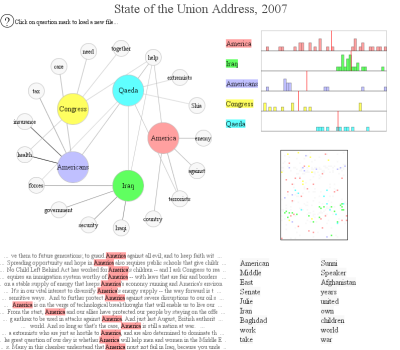 I don't know how to use this for analysis, but it's interesting.
I don't know how to use this for analysis, but it's interesting.3.21.2007
IJED CFP
The listserv of the Informational Technology and Politics section of APSA recently ran a Call For Papers by the forthcoming journal International Journal of Electronic Democracy:
"Democratic Internet - Foundations, Ideas, Approaches, and New Perspectives"
"Democratic Internet - Foundations, Ideas, Approaches, and New Perspectives"
3.20.2007
What is Web 2.0?
Anyone in the College Park area next Tuesday (March 27) may want to stop by the Maryland Institute for Technology in the Humanities (located in McKeldin library) to catch Byron Hawk's (GMU) talk on “Identifying Web 2.0: Remixing Institutional Identities:”
"... systems such as Zotero (GMU) and Digital Notebook (Georgetown) are being developed to take advantage of Web 2.0 capabilities such as citing, tagging, and cross referencing content across systems, the issue of identity is still in flux. ... newer CMS systems are centered on the production of a university or scholarly identity. This paper will examine the possibility of accepting the personal and subcultural identities that will inevitably emerge with the development of Web 2.0 research tools."I'm not sure what he means, but it sounds interesting.
3.19.2007
Nerd camp
The Institute of Social Research (U Michigan) offers dozens of useful short courses through its Summer Institute in Survey Research Techniques. I'd like to draw attention to two:
- Qualitative Data Analysis: With and Without Computers (Weitzman, UMass)
- Combining Qualitative and Quantitative Methods (Pearce, UNC)
Han's-on monitors
Last year at TED, NYU engineer Jeff Han tweaked everyone's imagination with his new multi-touch monitor. Well, he was back at TED this year, and it's clear that he's been working hard:
I doubt we'll see these in BestBuy soon, but it makes one wonder what computing may look like in another generation.
Addendum: FastCompany has an interview with Han that's worth a skim, as does Wired. Also, another video with better commentary:
I doubt we'll see these in BestBuy soon, but it makes one wonder what computing may look like in another generation.
Addendum: FastCompany has an interview with Han that's worth a skim, as does Wired. Also, another video with better commentary:
3.18.2007
eInfrastructure
Last Fall, the NSF sponsored a workshop in Ann Arbor on the History and Theory of Infrastructure: Lessons for New Scientific Cyberinfrastructures. The summary report is now available.
Beginning with the premise that development of electronic media to support scientific research may be informed by studying other infrastructures, participants explored issues of path dependence, 1st and 2nd-order distributional impacts, and the underlying (political) philosophies that "ought" to be central to the design of a cyberinfrastructure. These last include broad participation and collaboration, both within and across disciplinary boundaries.
My own sense is that we're in something of an "eCambrian era"- we've known for some time that traditional intellectual divisions are sub-optimal, but are only beginning to realize how specialized "noetic cells" may combine to form whole new "knowledge species."
 Hold onto your hat - over the next few decades, we'll experience a profound shift in how knowledge is acquired, assessed, organized, and communicated.
H/T to William H Dutton (Oxford) for the link.
Beginning with the premise that development of electronic media to support scientific research may be informed by studying other infrastructures, participants explored issues of path dependence, 1st and 2nd-order distributional impacts, and the underlying (political) philosophies that "ought" to be central to the design of a cyberinfrastructure. These last include broad participation and collaboration, both within and across disciplinary boundaries.
My own sense is that we're in something of an "eCambrian era"- we've known for some time that traditional intellectual divisions are sub-optimal, but are only beginning to realize how specialized "noetic cells" may combine to form whole new "knowledge species."
 Hold onto your hat - over the next few decades, we'll experience a profound shift in how knowledge is acquired, assessed, organized, and communicated.
H/T to William H Dutton (Oxford) for the link.
Copyright as graphic novel
The latest Digital Copyright Digest mentions Aoki, Boyle and Jenkins' "Bound by Law?", a detailed discussion of copyright, told as graphic novel. The book is a project of Duke's Center for the Study of the Public Domain.
 While I doubt we'll see a movie version anytime soon, it does a fair job of detailing the complexities (and absurdities) of American copyright law. It's also unusual enough that undergrads may actually do the assigned reading (also available as a FREE pdf download).
While I doubt we'll see a movie version anytime soon, it does a fair job of detailing the complexities (and absurdities) of American copyright law. It's also unusual enough that undergrads may actually do the assigned reading (also available as a FREE pdf download).
3.16.2007
Factoids
Last summer, Edublog Award nominee and high school teacher Karl Fisch put together "Did You Know?", a webvid of historical and geopolitical benchmarks for education and technology. An updated version "Shift Happens" (edited by Scott McLeod) is now online:
Personally, I think it becomes most interesting around 4:25.
3.13.2007
Trusted computing
Yet another compelling political video, this one on Trusted Computing. Produced by Benjamin Stephan and Lutz Vogel, it puts forth a straightforward argument about the political implications of this industry-centric idea.
Worth a look, if only for the pedagogical style.H/T to Howard Rheingold at SmartMobs for the link.
Discourse, redux
We're going to try an experiment - opening posts to comments. We used to allow them, but stopped due to excessive spam. To try to control for this, comments will be moderated based on relevance and word verification.
Welcome to the agora.
Addendum: moderating is not a habit for us yet, so don't worry if it takes a day or so for your comment to post.
Welcome to the agora.
Addendum: moderating is not a habit for us yet, so don't worry if it takes a day or so for your comment to post.
3.12.2007
Zotero@MITH
The Maryland Institute for Technology in the Humanities is having Dan Cohen (George Mason) on campus tomorrow (3.13) to present on "Zotero and the Promise of Social Software in Academia." His talk will be in MITH's Conference Room, B0135 McKeldin from 12:30-1:45pm.
Dan is a History professor with an interest in the role of computing in scholarship. In addition to his work on Zotero, he published "Digital History: A Guide to Gathering, Preserving, and Presenting the Past on the Web," a well-reviewed guide for practitioners.
Addendum: I just got back from Dan's talk - fascinating stuff, I'm quite intrigued to see where this evolves. I especially like the "scholarly primitives" and the Web 2.0 aspects of the project.
Dan is a History professor with an interest in the role of computing in scholarship. In addition to his work on Zotero, he published "Digital History: A Guide to Gathering, Preserving, and Presenting the Past on the Web," a well-reviewed guide for practitioners.
Addendum: I just got back from Dan's talk - fascinating stuff, I'm quite intrigued to see where this evolves. I especially like the "scholarly primitives" and the Web 2.0 aspects of the project.
gCensus
I've been a fan of GoogleEarth since it was used to report on the London transit bombings. Photos and commentary from those directly affected were available within an hour of the attacks, all in a data-rich spatial context.
 Mashups appeared as soon as Google released the APIs for GoogleEarth (and its online cousin, GoogleMaps). The latest (by Imran Haque) spatially embeds US Census data, enabling users to see population and wealth distributions, voting patterns, and more - all within geographical context.
By making the KML formating code open-source, Haque hopes others will begin adding additional data.
H/T to John Battelle for the link. Also, thanks to Imran for clarification on the spelling of his last name and the direct link to his site (see comments).
Mashups appeared as soon as Google released the APIs for GoogleEarth (and its online cousin, GoogleMaps). The latest (by Imran Haque) spatially embeds US Census data, enabling users to see population and wealth distributions, voting patterns, and more - all within geographical context.By making the KML formating code open-source, Haque hopes others will begin adding additional data.
H/T to John Battelle for the link. Also, thanks to Imran for clarification on the spelling of his last name and the direct link to his site (see comments).
Spatial social science
Last December, the Center for Humanities, Arts and Social Sciences* (UIUC) hosted "Spatial Thinking in the Social Sciences and Humanities."
 The ten speakers addressed a range of issues, from Fundamental Spatial Concepts (Goodchild - UC Santa Barbara), to Enterprise and the Wealth of Villages (Townsend - U Chicago), to Political Science Across Time and Space (Cho UIUC), and more. Each is available as a RealPlayer video.
*CHASS is a "virtual institute" of the NSF-funded EPIC (Engaging People in Cyberinfrastructure) program, with the mission to "identify, create, and adapt computational tools that will accelerate research and education in the humanities, arts, and social sciences."
The ten speakers addressed a range of issues, from Fundamental Spatial Concepts (Goodchild - UC Santa Barbara), to Enterprise and the Wealth of Villages (Townsend - U Chicago), to Political Science Across Time and Space (Cho UIUC), and more. Each is available as a RealPlayer video.*CHASS is a "virtual institute" of the NSF-funded EPIC (Engaging People in Cyberinfrastructure) program, with the mission to "identify, create, and adapt computational tools that will accelerate research and education in the humanities, arts, and social sciences."
3.11.2007
Scientific publishing 2.0
Read/WriteWeb has a post on the SXSW panel Web 2.0, Semantic Web & Scientific Publishing, covering a couple of projects of interest to scholars:
- George Soros' Budapest Open Access Initiative seeks to make all scientific literature FREE and freely available. Go George!
- Connotea is a FREE online reference manager (similar to Zotero, but with more limited annotation capabilities), with the ability to share citations over the web, and export-to or import-from client reference manager systems (e.g., Endnote). Timo Hannay calls it "del.icio.us for scientific publishing."
3.10.2007
Sharing knowledge
Connexions is a non-profit website billed as a "place to view and share educational material made of small knowledge chunks called modules that can be organized as courses, books, reports, etc." All materials are Creative Commons Attribution licensed.
Currently, 3845 modules are available, including 201 classified as Social Science. Most seem to focus on Education, although Linguistics and Cognitive Science are strong, as well.
Connexions is based at Rice University, a school at the forefront of adapting (and adopting) information technology to the academic community.
Currently, 3845 modules are available, including 201 classified as Social Science. Most seem to focus on Education, although Linguistics and Cognitive Science are strong, as well.
Connexions is based at Rice University, a school at the forefront of adapting (and adopting) information technology to the academic community.
3.09.2007
Social science at Microsoft
The current issue of Technology Review has a thought-provoking interview with Marc Smith, senior research sociologist for Microsoft, who studies the development of online communities.
Turns out, the elements of his sociological training that make him useful to Microsoft are very much a part of Political Science: collective action theory. Issues such as free-riding are central to the formation of online communities (or lack thereof), and this is increasingly being acknowledged by tech companies.
Kate Greene (TR) points out that "Yahoo!, Intel, and Google are snatching up sociologists and economists in order to develop new products and optimize existing technology." Smith suggests that Microsoft may be planning to hire more, though he emphasizes that candidates would need "computer savvy."
Perhaps there's meaningful work for tech-oriented political scientists, as well...
Turns out, the elements of his sociological training that make him useful to Microsoft are very much a part of Political Science: collective action theory. Issues such as free-riding are central to the formation of online communities (or lack thereof), and this is increasingly being acknowledged by tech companies.
Kate Greene (TR) points out that "Yahoo!, Intel, and Google are snatching up sociologists and economists in order to develop new products and optimize existing technology." Smith suggests that Microsoft may be planning to hire more, though he emphasizes that candidates would need "computer savvy."
Perhaps there's meaningful work for tech-oriented political scientists, as well...
Jack into the Net
Gamespot News is reporting that Emovit Systems plans to release a brain/computer interface for video games sometime next year.
 According to the copy, the system senses brain electrical signals to "detect player thoughts, feelings and expression" (sic). It looks like a prop from eXistenZ.
Could be hype, but it sounds like a great advance for computer accessibility.
According to the copy, the system senses brain electrical signals to "detect player thoughts, feelings and expression" (sic). It looks like a prop from eXistenZ.Could be hype, but it sounds like a great advance for computer accessibility.
3.08.2007
Web 2.0, the Sequel
Cultural anthropologist Michael Wesch (Kansas State) has released an updated (and final) version of his video on Web 2.0: The Machine is Us/ing Us.
Really, a must-see (especially if you missed it the first time around).
Addendum: Wesch has also posted an introduction to the Digital Ethnography Working Group. Their goal is to study the "YouTube community" and produce short ethnographies about what they learn.
Each student has taken on a different core question (e.g., Organized Thought: Spread of Ideologies/Beliefs) and developed a research proposal.
I know of students here at Maryland who are studying political discourse in blogs, but haven't heard of anyone doing research on the role of online video in politics. Could be a fascinating thesis topic...
3.07.2007
Many, many eyes
Remember NameVoyager, the baby name data visualization that was a rage last year? Well, its developer has another experiment: Many Eyes.
 While it lacks many of the annotation features of Sense.us, since its public release last month it has gotten substantial attention - to date, 1,336 datsets have been uploaded, with 1137 separate visualizations.
I'm certain we'll see more like this soon (e.g., Data360, Swivel). I also predict that as the designs become more sophisticated (ability to generate statistical and structural metrics would be nice), and gain traction as collaborative media, we'll also see editing and viewing controls emerge (ala Google Docs). Imagine what it might mean to the scientific process when datasets and access codes are published along with scientific articles.
It will certainly change peer review.
Addendum: I should note that both Sense.us and NameVoyager were built using Prefuse, billed as a "Java-based toolkit for building interactive information visualization applications."
While it lacks many of the annotation features of Sense.us, since its public release last month it has gotten substantial attention - to date, 1,336 datsets have been uploaded, with 1137 separate visualizations.I'm certain we'll see more like this soon (e.g., Data360, Swivel). I also predict that as the designs become more sophisticated (ability to generate statistical and structural metrics would be nice), and gain traction as collaborative media, we'll also see editing and viewing controls emerge (ala Google Docs). Imagine what it might mean to the scientific process when datasets and access codes are published along with scientific articles.
It will certainly change peer review.
Addendum: I should note that both Sense.us and NameVoyager were built using Prefuse, billed as a "Java-based toolkit for building interactive information visualization applications."
3.06.2007
The practice of law
News of the weird, or sign of things to come? Kevin Poulsen at 27B Stroke 6 (WIRED newsblog) is reporting that the 9th Circuit has held that the web-based expert system Ziinet (now offline) has been practicing law without a license.
The case evolved from errors in a bankruptcy filing which a defendant claimed were made by his "legal counsel" - Ziinet. Henry Ihejirika, owner of the website, was convicted of fraud and practicing law with a license, a verdict now upheld.
According to Poulsen, "Ihejirika had a human lawyer for his defense."
The case evolved from errors in a bankruptcy filing which a defendant claimed were made by his "legal counsel" - Ziinet. Henry Ihejirika, owner of the website, was convicted of fraud and practicing law with a license, a verdict now upheld.
According to Poulsen, "Ihejirika had a human lawyer for his defense."
3.05.2007
Sense.us
Prepare to be blown away. Jeffrey Heer et al., have a new web-based ap to support asynchronous collaborative information visualization.
 According to the site, it supports "view sharing, discussion, graphical annotation, and social navigation and includes novel interaction elements." That may sound dull, but watch the Flash movie (a paper is also available).
Sense.us is amazing. Imagine how it could be used not only for collaborative research, but also as a way to prep data for lectures, or support in-class exploration by students.
Thanks to Mike Love at SmartMobs for the link.
According to the site, it supports "view sharing, discussion, graphical annotation, and social navigation and includes novel interaction elements." That may sound dull, but watch the Flash movie (a paper is also available).Sense.us is amazing. Imagine how it could be used not only for collaborative research, but also as a way to prep data for lectures, or support in-class exploration by students.
Thanks to Mike Love at SmartMobs for the link.
Political designs
Last March, Jennie Winhall asked the fascinating question "Is design political?" in an article for the design journal Core77.
 We should all be aware of the potential impacts of poor design, or the role of design in symbolic politics and agitprop; much less acknowledged are the more insidious effects of design-as-environment.
All underscore Winhall's point: design is a powerful tool with significant political implications. She argues this gives designers political and social responsibilities that are virtually ignored in the design industry today.
While I'm not in a position to pass judgment on that industry, so many aspects of design are inherent to teaching that I think educators would benefit from listening to her argument.
When was the last time you used PowerPoint, or moved chairs into a circle?
Thanks to Josh Porter for the link (he also has an interesting follow-up to Winhall).
We should all be aware of the potential impacts of poor design, or the role of design in symbolic politics and agitprop; much less acknowledged are the more insidious effects of design-as-environment.


All underscore Winhall's point: design is a powerful tool with significant political implications. She argues this gives designers political and social responsibilities that are virtually ignored in the design industry today.
While I'm not in a position to pass judgment on that industry, so many aspects of design are inherent to teaching that I think educators would benefit from listening to her argument.
When was the last time you used PowerPoint, or moved chairs into a circle?
Thanks to Josh Porter for the link (he also has an interesting follow-up to Winhall).
The Internet and society
William H Dutton (Oxford Internet Institute) has a list of Centres for Research on the Internet and Society that is worth a look.
It should be no surprise to anyone, but as the social relevance of information technology has grown, so has academic interest in understanding the causes and effects of such processes. While the list is not exhaustive, it offers a good jumping off point for those interested in these issues.
It should be no surprise to anyone, but as the social relevance of information technology has grown, so has academic interest in understanding the causes and effects of such processes. While the list is not exhaustive, it offers a good jumping off point for those interested in these issues.
Sweet Tools
Michael K Bergman has put together a very impressive list (420 entries) of Web 2.0 aps. Covering functionality from annotation to language processing to visualization and more, nearly 90 percent are FREE and open source.
3.04.2007
Ch-ch-ch-ch-changes
Remember your first view of the web? Email?
Can you imagine professional life without either anymore?
Can you imagine professional life without either anymore?
Thanks to Download Squad for the link.
Subscribe to:
Posts (Atom)