4.28.2007

Money and Politics 2.0

MAPLight.org offers a well-designed interface for a rich dataset of bills, legislators, and money. Studying relationships between contributions and legislative voting is something of a tradition. Now everyone can join in!

Users can discover not only who gives the most, but the "success rates" for such "investments" (i.e., whether politicians supported their position). The data currently covers just California, but the plan is to add Congress next. Any chance this may improve the quality of political journalism? Of scholarship?

NOTE: Michael Calore has a write-up about MapLight on Wired.com: "Web Mashups Turn Citizens Into Washington's Newest Watchdogs."

UPDATE 5-17-07: MAPLight Congress is now live.

4.26.2007

1-Stop Shop for Web 2.0 Aps

A new community directory, called Listio, allows users to discover, submit, and vote for Web 2.0 applications.

4.23.2007

ISO the perfect wiki

I've been perusing the Wiki tools page of Using Wiki in Education, in search of the perfect tool for one of our projects.

The ideal approach would enable us to:
  1. create a simple interface for MySQL database records
  2. provide read-only access to those records
  3. use controlled taxonomies and/or folksonomies
  4. support password-protected profiles
  5. allow profiles to tag and annotate records
  6. review and compare profiles for inter-coder agreement
  7. query by tag or comment
  8. append approved tags and comments to MySQL records
The project is a large text corpus that we are studying from a variety of methodological approaches, from content extraction that can't be fully automated, to semantic tagging and more fully "grounded" approaches.

Such a tool should have very broad applicability throughout the social sciences and law - indeed, any discipline that relies heavily on textual evidence.

Any suggestions would be enormously helpful.

4.20.2007

CFP: Digital Humanities

Via the Stoa Consortium, news that next October 21-22, Northwestern University (Chicago) will host the second Chicago Colloquium on Digital Humanities and Computer Science. The theme is "exploring the scholarly potential of high quality text and image archives in a collaborative environment."

My only question is who will hold the first US Colloquium on Digital Social Science? I realize we're a retro lot, but really - the world has changed. Let's move beyond pencils and post-its.

4.13.2007

Visualizing development

At last year's TED, Hans Rosling (Karolinska Institutet) presented a series of utterly amazing visualizations of world health and wealth data.


Produced by Gapminder (which Rosling founded).

H/T to Moritz Stefaner (Well-formed data) for the reminder.

Information U

John Milan (Read/WriteWeb) has an interesting post on how "Web 2.0's Future All Depends on IT's Future." While most of the article focuses on the role of CIOs in selecting the next generation of IT winners, he closes with a brief discussion of Doug Neal's (Leading Edge Forum) contention that corporations would do better to focus on an "educational" (rather than surveillance) model, where IT is used to enable the sharing of ideas. Think of it as a "wisdom of crowds" for the corporate world.

Which leads me to wonder (yet again) the degree to which IT serves such purposes in the social sciences. True, most of us at least rely heavily on email. But how well have we really learned to use IT to facilitate our research? How many of us have a technological aptitude on par with our (other) intellectual training? Are our skills better or worse than those of the students we are tasked with educating?

I'm currently designing a brief survey to try to assess this question, which I'll deploy it later this month. I'm quite interested in hearing the attitudes and experiences of others on these issues. Comments and suggestions (substantive or strategic) are heartily encouraged.

4.11.2007

The Enigmatic Art of Knowledge Representation

Conrad Barski has put together a short tutorial called"How To Tell Stuff To A Computer - The Enigmatic Art of Knowledge Representation"

While this is mostly intuitive, I think his tripartite schematic ("guy in the garage," "writer," and "scientist") is useful for thinking about IT at the intersection of social science, on the one hand, and humanities, on the other.

As someone with first hand experience with the difficulties of straddling the traditional "two cultures" divide, and who has thought (perhaps mistakenly) that IT could serve as a bridge between the two, I think the "art of knowledge representation" sheds light on the realistic opportunities and limitations of employing computer science to that end.

4.10.2007

Sophie's choice

Sophie is an open-source multimedia platform that enables users to create rich and elegant text, video, audio and image files without programming skills.

An alpha version is available now (beta due in September). Perhaps more interesting, developers plan to make a OLPC version ($100 laptop) available.

4.09.2007

Tinderbox tools

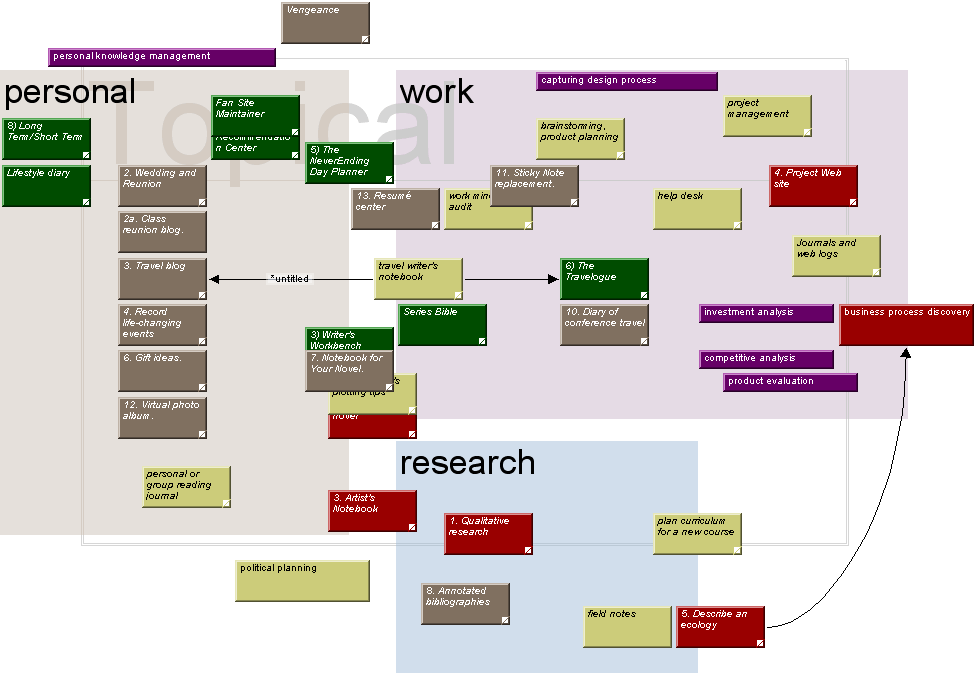
Eastgate Tinderbox is a personal content management system for Macs that lets users store, organize and share notes, ideas and plans over the web, and offers a variety of visualizations to facilitate analysis and understanding.

I've been looking for something similar for Windows, to no avail. I'm very impressed by the architecture of this program.

4.08.2007

New Online Journal: DHQ

DHQ (Digital Humanities Quarterly) is an open-access, peer-reviewed, digital journal covering all aspects of digital media in the humanities. Published by the Alliance of Digital Humanities Organizations (ADHO), DHQ is also a community experiment in journal publication, with a commitment to:
  • experimenting with publication formats and the rhetoric of digital authoring
  • co-publishing articles with Literary and Linguistic Computing (a well-established print digital humanities journal) in ways that straddle the print/digital divide
  • using open standards to deliver journal content
  • developing translation services and multilingual reviewing in keeping with the strongly international character of ADHO

4.07.2007

Copyright 499: Pwned

I've mentioned his work before, but if Cory Doctorow is still not on your radar, check out Brock Read's latest in the Chronicle of Higher Education: "A Blogger Infiltrates Academe."

An Annenberg Fellow at USC this year, Mr. Doctorow teaches an upper- division course on copyright (and copywrong). His students are podcasting the class; sound quality is sub-optimal, but I find them immensely informative and entertaining.

Another interesting note: frustrated by Blackboard's CMS, Mr. Doctorow and his students established a blog to manage course content. Well worth a look.

Playing with data

The Parsons Institute for Information Mapping (New School) has put together a nice visualization that shows Electoral College results going back to 1789 in terms of the familiar "red state, blue state" maps.

The color-coding is sometimes a bit odd (Dems, Federalists and Whigs are all blue), but quite fascinating. I had no idea that both candidates in 1820 were Republican. The interface includes issue polling, though I don't know how to interpret the results. Overall, very interesting, likely useful for classrooms.

H/T to Statistical Modeling, Causal Inference, and Social Science for the link.

4.06.2007

Google advanced operators

Google search functions now summarized on this convenient "Cheat Sheet."

Online survey tool

QuestionForm is an online survey tool that supports drag-and-drop design, standard response formats (multi- and radio choice, Likert scaling, narrative), linear and non-linear sequencing, multiple languages, etc.

It's FREE for 2 surveys per month (5 questions each), but for $20/mo, users can run 8 surveys (with unlimited questions). Results can be viewed live, via RSS or email, or exported to spreadsheet programs.

Along similar lines, you might consider Form Assembly, SurveyMonkey, PHPSurveyor, PollBuilder, or UM's survey system (for UM faculty and staff). Stephen Gourlay also put together a brief summary of online surveying a couple of years ago.

H/T to DownloadSquad for the QF link.

4.05.2007

MySpace primary

Experiment? Publicity stunt? TechCrunch is reporting that MySpace will hold a presidential primary next January.

If you look at the candidates' pages, it seems McCain is not the only one with design issues - of current frontrunners, only Clinton, Obama, and McCain appear to have hired a real programmer. Giuliani's is set to private, which seems antithetical to the whole principle of MySpace.

It remains to be seen whether any of this will mean anything at the caucus or the ballot. But it's certainly different.

4.04.2007

Transana

For those who need to transcribe or tag audio-video files, the first commercial version of Transana was just released. I found the earlier, freeware versions doubled my transcription speed; in addition to offering a Mac OS X version, this release supports several new functions:
  • Easily make clips of longer files
  • Support for MOV, MP4, WMV video and WMA audio
  • Coding visualizations instead of waveforms
  • Supports longitudinal analysis of keyword use
  • Export data for statistical analysis
At $50 for an individual license, Transana isn't the deal it once was - but the folks at UW-Madison have designed a solid application for serious users.

Image annotation

Those who need to tag or annotate elements within still images (e.g., maps, historical documents) may find the Image and Map Annotation Notebook interesting. ImaNote is a FREE open-source annotation tool that enables users to display and tag images online. It's based on the Zope open-source content management platform, which you would first need to install.

Of course, such functionality is widely available via Flickr (without Zope), but it appears ImaNote's user-base may be a bit more staid.

4.03.2007

Cyberinfrastructure

For background on the previous CFP, check out the NSF's "Cyberinfrastructure Vision for 21st Century Discovery."

From the Executive Summary:
"Data, Data Analysis, and Visualization are vital for progress in the increasingly data-intensive realm of science and engineering research and education. Any cogent plan ... must address the phenomenal growth of data in all its various dimensions. Scientists and engineers are producing, accessing, analyzing, integrating, storing and retrieving massive amounts of data daily ... a trend that is expected to see significant growth in the very near future as advances ... automated data acquisition ... and other methods and technologies materialize. The anticipated growth in both the production and repurposing of digital data raises complex issues not only of scale and heterogeneity, but also of stewardship, curation and long-term access."
'nuf said.

e-Social Science 2007

The NSF has teamed up with the UK's National Centre for e-Social Science to host the e-Social Science Conference 2007 this October 7-9, in Ann Arbor, MI.

A Call for Papers has just gone out - suggested topics include:
  • Case studies of research methods, aps, and practices enabled by cyberinfrastructures and tools
  • Benefits and challenges of large-scale, distributed, collaborative, and interdisciplinary research
  • New tools for sociological data sharing, access, security, analysis, and preservation
  • Tools for enabling new sources of data and data collection
  • Ethical challenges and solutions raised for collection, sharing, and analysis of socioeconomic data
  • Case studies of the design and development of e-Research methods, technologies, and tools
The UK is ahead of the US on this issue; this year's conference is a big step forward for social science on this side of the pond.

4.01.2007

In(fo)security

I wish this were only an ill-advised April Fool's joke: on Friday, the NYTimes reported that the National Nuclear Security Agency can't account for 20 of its computers, 14 of which hold (held?) classified data. Yeah, those guys again.

It's bad enough we can't protect the data of our military personnel.