5.16.2007

New QDA Miner beta

Normand Peladeau at Provalis Research has just released a beta version of QDA Miner 3.0.

New features include:
  • Support for image coding (bmp, wmf, jpg, gif, png)
  • Query by example (e.g., "find things like this")
  • Automatic document classification (i.e., machine learning)
  • Greater integration with WordStat
  • ... and much, much more.
Mike and I are both long-time Provalis users, but we are still discovering features of this powerful software suite (QDA Miner, Wordstat, Simstat).

For my money, it's the best thing out there if you study text (qualitatively, quantitatively, or both).

5.12.2007

Intercoder agreement

There's been a lot written about the relative merits of folksonomies vs controlled vocabularies (i.e., tagging), but few frame it in terms of intercoder agreement (measures by which content analysts assess coding reliability).

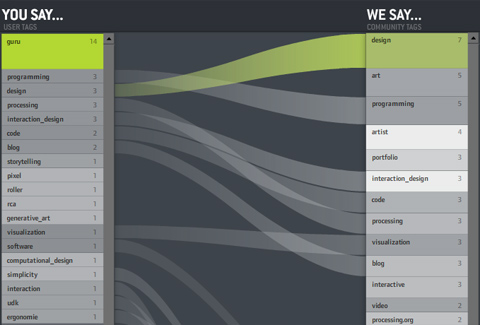
Recently, Moritz Stefaner at Well-formed Data posted a visualization to compare tagging practices, which could be a useful tool to draw researchers' attention to discrepancies across multiple coders.

A few annotation (aka "code-and-retrieve") packages currently come with embedded intercoder agreement tools. Fewer make much use of visualization tools, generally. My advice to developers is to seriously integrate both functions into the design of next generation CAQDAS software.

5.08.2007

American Presidency Project

John Woolley and Gerhard Peters at the University of California, Santa Barbara have produced an impressive collection of Presidential materials from Washington to present. As they describe it:
"The American Presidency Project is the only online resource that has consolidated, coded, and organized into a single searchable database:
  • Messages and Papers: Washington - Taft (1789-1913
  • Public Papers: Hoover to Bush (1929-1993)
  • Weekly Document Compilation: Clinton - G.W. Bush (1993-2007)"
Quite impressive. I hope the next step is to apply more sophisticated text mining tools to the corpus and organize the data to take fuller advantage of Web 2.0 capabilities.

5.05.2007

The future of research

From Language Log, Mark Liberman offers one of the most succinct explanations for why tech literacy is becoming critical for scholars of all disciplines. His notes from an NSF-sponsored workshop in Phoenix:
"By 2015, all publicly-funded research products and primary resources will be readily available, accessible, and usable via common infrastructure and tools through space, time, and across disciplines, stages of research, and modes of human expression."
Both Mike and I focus on developing tools and techniques for this new milieu; the mystery is how to engage our colleagues. I'm always asked to help senior faculty with things like email, but I'm also often surprised by the lack of tech saavy (or even interest) among grad students.

How do we help social science prepare for a digital academy? How do we raise awareness that it is going to happen?